

Maryland EV Charging: What Comes Next?
What will it take to move Maryland’s transportation plans from policy documents to reliable infrastructure? That question will shape one discussion at the 2026 Maryland Clean Energy Summit.
The 2026 Maryland Clean Energy Summit takes place October 13 and 14 at the College Park Marriott Hotel & Conference Center. Its “Beam Me Up, Scotty: Climate & Transportation of the Future” roundtable will examine Maryland’s readiness for changing transportation technologies.
Dave Castille, Director of Public Sector at Blue Whale EV, will join the roundtable. Before the event, MCEC asked him about the practical issues behind EV charging deployment: permitting, utility coordination, grid capacity, project costs, and driver confidence.
From a statewide plan to chargers in the ground
Maryland’s Zero Emission Vehicle Infrastructure Plan provides a roadmap for public Level 2 and direct-current fast charging infrastructure. It also gives state agencies tools for coordination, investment, and site selection.
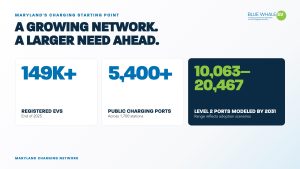
MDOT reports that Maryland had more than 149,000 registered electric vehicles at the end of 2025. More than 5,400 public charging ports at 1,700 stations supported those drivers. By 2031, MDOT estimates that the state can need about 10,063 to 20,467 public Level 2 ports, depending on adoption.
MCEC: From your perspective, where is Maryland making progress, and where is the gap?
Dave Castille: “I would say Maryland is on target with what it wants to do. It is behind in actual deployment and getting the infrastructure out there.”
MCEC: What is the biggest bottleneck between having a plan and putting chargers into the ground?
Dave Castille: “Funding is a big thing. Permitting is a big thing. Working with utilities is a big thing.”
A property owner can select a charger and identify a location. The project still needs electrical capacity, utility coordination, engineering, permits, and funding. Those requirements often overlap.
Why permitting can take longer than construction
MCEC: Does the permit process vary by county?
Dave Castille: “Absolutely. We can get through some counties in a day or less. Other counties can take three to six months, if not longer.”
Castille supports strong safety rules and local code compliance. His question is whether the review process matches the scope of a routine charging project. A standard site installation can pass through many reviewers even though it is smaller than a new building.
MCEC: If you could change one policy tomorrow to speed deployment, what would it be?
Dave Castille: “I would find a way to fast-track permitting. We still want to obey all regulations and local codes. The question is whether the review process matches the project’s scope.”
Utility design and approval can add more time. Castille said that permitting and utility work together can take 12 to 18 months on some Blue Whale EV projects. Construction can then take only a few weeks.
Dave Castille: “It is not uncommon for us to spend about a year on utility design and permitting. It can take a year to complete that work, while the construction can take only three weeks.”
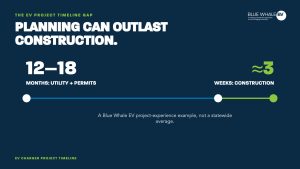
These timelines describe Blue Whale EV’s project experience. They are not statewide averages.
What good utility coordination looks like
MCEC: What does good collaboration between a utility, property owner, and installer look like at a site?
Castille described a recent site visit with the customer, utility engineers, and Blue Whale EV’s design team. The first proposed charger location was far from the utility connection and raised stormwater concerns. Together, the group found a closer and less expensive location before design work began.
Dave Castille: “A site walk with the utility, property owner, and Blue Whale EV makes the process much smoother than passing documents back and forth.”
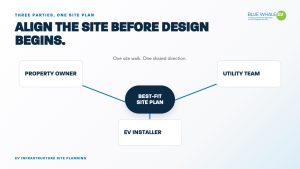
This early coordination is part of Blue Whale EV’s turnkey planning and site-assessment process. It can prevent separate plans, late utility objections, and repeated revisions.
Dave Castille: “The three parties can develop one plan together. The property owner, installer, and utility can agree on the probable best option.”
The lower-cost option also made the project more likely to proceed. As Castille noted, a larger design can create more work and revenue, but it does not help if the customer cannot afford to build it.
Can the grid support more EVs?
MCEC: How ready is Maryland’s grid for the EV adoption that the state is planning?
Dave Castille: “The grid is probably okay, although it needs some upgrades. I do not think the grid situation is as catastrophic as some people have said in the past.”
Smart charging can shift vehicle demand to overnight hours and reduce demand charges. That approach works well for vehicles that return to a depot. A 24-hour fleet needs a different plan because chargers must remain available throughout the day.
Battery-buffered charging offers another option. A battery can charge when demand is lower and supply vehicles during busy periods.
Dave Castille: “We are looking at systems with a battery buffer. The battery charges overnight and supplies vehicles during the day. It is interesting technology.”
The right design depends on vehicle schedules, site capacity, utility requirements, and charging speed. These questions are especially important for government EV charging projects, which must balance access, operations, budgets, and procurement rules.
What is driving fleet electrification?
MCEC: What is driving businesses to electrify their fleets: cost, regulation, customer pressure, or something else?
Dave Castille: “I think it is operating efficiency and lower cost over time. Electric vehicle prices are moving closer to comparable gasoline vehicles.”
Castille offered a simple energy-cost comparison. A gasoline truck that gets 20 miles per gallon costs about 20 cents per mile when gasoline costs $4 per gallon. An electric truck that gets two miles per kilowatt-hour costs about 7.5 cents per mile when electricity costs 15 cents per kilowatt-hour.
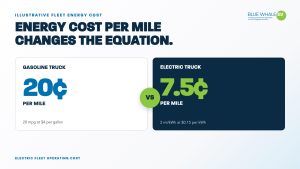
Dave Castille: “Seven or eight cents compared with 20 cents is a large difference.”
Actual costs vary by vehicle, route, charging schedule, utility rate, and fuel price. Electric vehicles can increase tire costs because they are heavier. They remove oil changes and engine air filters, while regenerative braking can reduce brake wear.
The result is not a universal answer. Each fleet must calculate its routes, dwell times, energy use, maintenance, and charging requirements before it buys vehicles.
What property owners often misunderstand
MCEC: What do commercial property owners get wrong about the cost or complexity of charging?
Dave Castille: “They can think that it is like plugging something into a wall. Then they hear the price and wonder why it costs so much.”
Many older properties do not have enough electrical capacity to add chargers easily. A project can require a new utility service, transformer, switchgear, or electrical panel. An existing panel can make the work simpler, but many sites need utility work from the start.
That is why early site assessment matters. Charger selection is only one part of the project. The electrical system, utility process, civil work, permits, and vehicle use case determine the final scope.
What success looks like in five to ten years
MCEC: Five to ten years from now, what does success look like for Maryland’s transportation infrastructure?
Dave Castille: “I would like 25% to 30% of vehicles to be electric. I would also like EV charging to be almost as easy as gasoline fueling in availability and reliability.”
For Castille, success is practical. A driver must be able to leave an interstate and reliably find an available, working charger. That includes useful locations, clear highway signs, and enough charging speed for the stop.
Dave Castille: “Drivers see highway signs for gas stations, but they do not see the same signs for EV charging.”
Faster vehicle and battery systems will also help. Castille said that charging from 20% to 80% in 20 to 25 minutes is realistic for some new systems. The charging session then becomes an extended rest stop.
Reaching that outcome will require more than hardware. Maryland needs coordinated utilities, realistic funding, consistent permitting, reliable equipment, and project teams that begin with each site’s needs. Public agencies also need practical ways to buy complete solutions. Blue Whale EV’s public-sector contract vehicles combine charging equipment with design and installation services.
These answers preview one part of a broader discussion about Maryland’s transportation future. Castille will continue the conversation during the “Beam Me Up, Scotty: Climate & Transportation of the Future” roundtable.
Learn more about the 2026 Maryland Clean Energy Summit and ticket options. Organizations planning government or fleet infrastructure can also explore Blue Whale EV’s approach to public-sector EV charging projects.
Frequently asked questions about the 2026 Maryland Clean Energy Summit
When and where is the 2026 Maryland Clean Energy Summit?
The summit takes place October 13-14, 2026, at the College Park Marriott Hotel & Conference Center. The venue address is 3501 University Boulevard East, Hyattsville, Maryland 20783.
What time should attendees arrive?
The current summit agenda lists registration and a networking breakfast at 7:30 a.m. on both days. The main program begins at 9:00 a.m. Attendees who want breakfast and networking time can arrive before the opening program.
What is included in the summit schedule?
The two-day agenda includes eight roundtable discussions, eight breakout sessions, four plenaries, and six networking opportunities. It also includes breakfast on both days, a Day 1 networking reception, and a Day 2 awards luncheon.
When is Dave Castille’s transportation roundtable?
The current Day 2 agenda places “Beam Me Up, Scotty: Climate & Transportation of the Future” in the 11:00 a.m. roundtable block. The listed location is Room 1105. Attendees can check the official agenda before the event for schedule or room changes.
What ticket options are available?
MCEC offers full-conference and single-day tickets. The ticket page lists full-conference registration at $625 and single-day registration at $375. Late-registration prices begin October 1. Government and nonprofit rates are available at checkout, and tickets are limited.
Where should attendees check for updates before the summit?
Attendees can use the official summit agenda for program and room information. The official ticket page provides registration details and current pricing.
Legal Disclaimer:
EIN Presswire provides this news content "as is" without warranty of any kind. We do not accept any responsibility or liability for the accuracy, content, images, videos, licenses, completeness, legality, or reliability of the information contained in this article. If you have any complaints or copyright issues related to this article, kindly contact the author above.
